 简体中文
简体中文  English
参考
HVAC Wiring Reference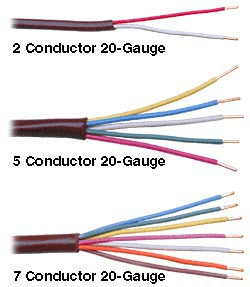 Features of Reference
- 联合电缆有一些特殊颜色的电线用于恒温器/暖通空调使用
- 它可用于两导体多达十个导体版本
- 选择20-ga。运行长达250英尺高达4A和18-ga。运行超过200英尺高达8A
Color-Coded Cable Reference
This color-coded cable specifically supports thermostat/HVAC use and helps you easily track which color wire operates each function (i.e. Black=Ground, Red=24VAC, White=Heat, Green=Fan, Yellow=Compressor, and so on). This reference helps installers and technicians maintain clarity and consistency during wiring, ensuring accurate connections and efficient system performance.
Conductor Requirements for Different Systems
对于仅加热系统,2导体电缆通常会存在,这种情况下的恒温器可以是水银开关或其他不需要电源的机械类型。提供加热或冷却的大多数系统将具有4或5根导体电缆。多级系统需要高达7导体的电缆。使用20-ga。运行高达250英尺高达4A,18-ga。运行超过200英尺高达8A。
Notes on grounding: If no blue or black wire connects to a COM terminal, the thermostat is likely a mechanical or mercury bulb type that does not require power. It may also be a ‘power stealing’ type which doesn’t require the ground or ‘common’ from the transformer since these types scavenge a very small amount of power that returns through the various outputs of the thermostat without actually turning on the equipment. Because Bravo communicating thermostats draw more power than can be scavenged, they must use a separate COM connection to the transformer
In a new installation, this is not a problem, but in an existing retrofit application you may need to run an extra conductor if there isn’t a spare available in the existing cabling. Sometimes installers snip spare wires inside the wall, so check the cable all the way up to where the stripping starts for cut wires. Final note: since you are (probably) running a new communications cable to the Bravo communicating thermostat anyway, you will have a GND conductor on the RS485 cable which could be used, in which case you will tie the transformer for the particular HVAC equipment in with the network GND.
Notes on Grounding
Notes on Existing Cabling: In a retrofit situation you will often see the Rc and Rh wires jumpered on an existing installation, in this case a single transformer powers both the heating and cooling equipment which is the most common type. If you see the Rh and Rc as separate conductors not jumpered at the thermostat, you can likely conclude that two separate transformers power the system—one for heating and another for cooling.
This reference serves as a practical guide for selecting the right thermostat/HVAC wiring, ensuring proper installation, grounding, and reliable system performance.